
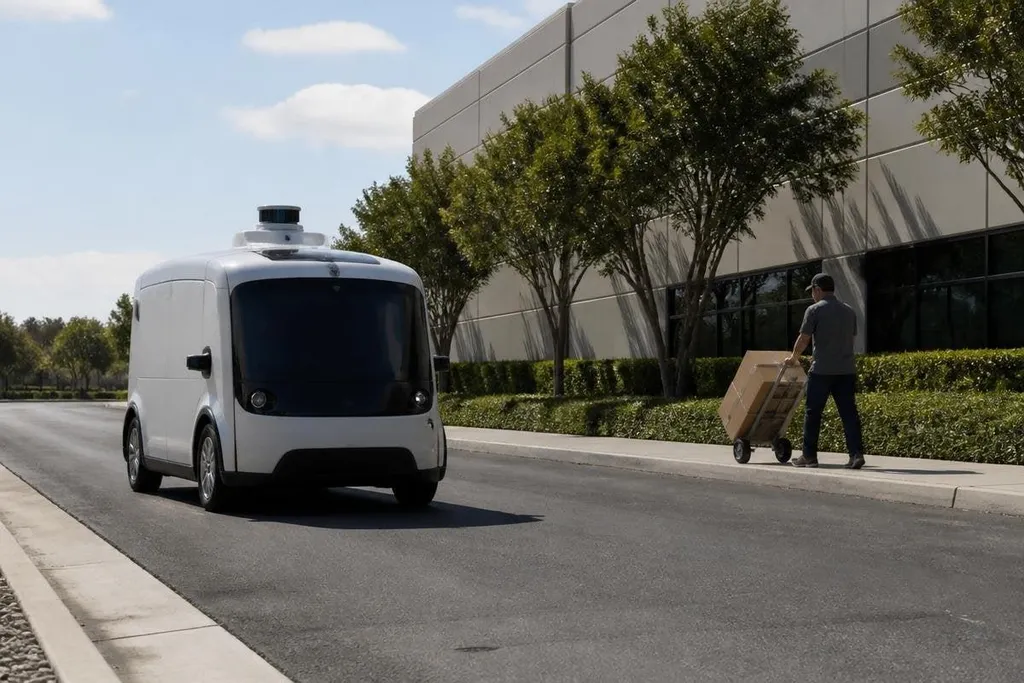
Self-driving vehicles still need to understand roads, people, weather, maps, and their own limits. The next stage of autonomous driving will start with tasks a vehicle can handle safely, while broad street coverage remains harder.
Quick read
- Driverless services will grow first on mapped routes and controlled sites.
- Cameras, radar, LiDAR, maps, and remote help each cover different risks.
- Human attention will still matter where road conditions fall outside the system’s design.
The first useful jobs are predictable
Autonomous vehicles work best when the operating area has clear limits. A shuttle on a fixed route, a truck moving between two parts of a port, or a delivery vehicle serving a defined district gives the system fewer situations to handle than a car crossing an entire country.
That narrower job changes the engineering problem. The vehicle can build detailed maps, check road rules in advance, and test its driving software against the same streets many times. If road work or a new traffic pattern appears, operators can update the map or restrict the service area while the issue is checked.
The value is practical. The system doesn't need to drive everywhere to reduce work for a transport operator. It needs to complete a repeatable trip with fewer stops caused by fatigue, staffing gaps, or limited operating hours.
How the vehicle sees the road
An autonomous vehicle combines several types of information. Cameras read lane markings, signs, lights, and object shapes. Radar measures distance and movement, including in conditions where a camera has less useful detail. LiDAR sends out light pulses to build a three-dimensional view of nearby objects.
Software joins those inputs with maps and positioning data. It then estimates where the vehicle is, predicts how nearby road users may move, and selects a safe path. That process runs again and again as the vehicle moves.
No sensor solves every problem. Bright sunlight can affect cameras. Rain, snow, or dirt can reduce the useful range of sensors. A map can become outdated when a lane closes or a temporary barrier appears.
Safe operation depends on the vehicle noticing uncertainty and slowing down, stopping, or handing the task to a remote operator.
A vehicle that hands control to a remote operator still needs a clear record of when and why it did so. Robot24 can tie that handoff to the vehicle, route, test date, and operator role before the edge cases begin.
The hard part is the edge case
A clear road is not the main test. The difficult moments include a person stepping out from behind a parked vehicle, an emergency vehicle approaching from an unusual direction, a faded lane line, or a road worker giving hand signals that conflict with the traffic lights.
People handle these events with broad experience and quick judgment. An autonomous system has to turn them into data, rules, and tested responses. That work takes time because rare events are hard to collect and reproduce safely.
Remote assistance can help when the vehicle reaches a situation outside its planned operation. The remote worker may confirm a route or explain an unusual scene, while the vehicle still controls its own movement. This reduces the need for a person to sit in every vehicle, but it does not remove the need for trained staff.
What changes for drivers and operators
Private car ownership will probably see slower change than fleet transport. A fleet can use a fixed vehicle type, maintain its sensors on a schedule, and send vehicles through known areas. A private car must handle many roads, changing weather, unfamiliar destinations, and drivers who may not understand when they need to take control.
That difference affects the business case. Operators can measure completed trips, stops, safety events, and the time a vehicle spends waiting for help. Car buyers need a system that works across ordinary daily travel, with clear warnings and enough time to respond when automation stops.
I'd judge an autonomous system by its limits and recovery steps before its smoothest demonstration. One that stops in the right place and asks for help gives you a clearer safety story than one that performs a short route without showing what happens next.
A practical buying and deployment check
Use these questions before approving an autonomous vehicle project:
- Defined area: Can the vehicle stay within a mapped service zone?
- Fallback plan: What happens when sensors disagree or the map is wrong?
- Remote support: Who responds, how fast must they act, and what can they control?
- Maintenance work: How will staff clean, inspect, and replace sensors?
- Safety record: Which events are measured, and who checks the reports?
- Human role: Does the operator know when the system has reached its limit?
The next phase will be judged by repeat trips in difficult but known conditions, not by a single smooth demonstration. The useful question is narrow: which route can this vehicle run safely, and what happens when that route stops being ordinary?